


Case Study: A Tailored Equine Fitness Plan to Address Specific Challenges

Updated:
August 15, 2025By Jec A. Ballou
Given the various components of fitness, conditioning plans can vary widely from horse to horse. Some need a program of mostly therapy-based exercises to address coordination, postural, or mechanical deficits before moving on to aerobic and gymnastic gains. Others need a restructuring of their workouts and plenty of good hard efforts to push past performance plateaus.
Occasionally, horses fall somewhere in between, which is tricky territory. These athletes need daily corrective exercises to target muscular or postural imbalances, but they are also capable of maintaining a decent level of aerobic activity for general fitness. In other words, there are physical challenges to address with slow methodical work, but they are not so severe that the horse’s activities need to be sharply restricted. If programs are too easy for too long, the horse stops making gains. If we focus only on therapy-based routines at the expense of gymnastic efforts, these horses end up losing the supplemental benefits of increased fitness to support better movement, resilience, and muscular activity.
Dean, a six-year-old Quarter Horse, was one of these athletes. His owner contacted me for a fitness plan to recondition him following a thorough rehab from a bilateral meniscus tear, which is a common cause of stifle lameness. By this point, Dean was walking and trotting under saddle for a total of 30 minutes following several months of hand-walking.
Related: Is This Hard for My Horse?
While he had by no means regained full fitness, Dean had a solid enough base to absorb a decent training load so long as it also contained routines to address the underlying weaknesses that might predispose him to reinjury down the road. In other words, we didn’t want to go full speed ahead on his cardio recovery without examining muscle patterns that contributed to stifle strain in the first place.
Watching videos of him moving, I noticed that Dean had a long stride for his height, which resulted in the tendency for his front end to cover a lot of ground while his hind legs trailed out behind. This type of locomotion can strain the hind joints versus flexing and loading them. The fitter and more energetically a horse moves in this posture, the more embedded it can become. Before starting the plan, his owner verified that his hoof balance had been closely examined to rule out the possibility of long toes contributing to the hind-end strain.
As I watched this athletic young horse, I realized we needed to help him to move better through his back to reduce concussion down through his limbs. Additionally, I hoped that by correctly activating the deep and locomotive muscles of his back, Dean would begin to draw his hind legs under him rather than trail them behind. This would enable us to strengthen the muscles that support his stifles.
To accomplish this goal, the plan would rely on a few pillars:
- Frequent short periods of cantering, but these would be done carefully to avoid amassing sustained time in the gait;
- Progressively increasing activity volume each week;
- A neutral/relaxed frame for riding, absolutely no working or collected frame;
- Using a very slow jog-trot, sometimes called a “rehab trot”;
- Corrective exercises to open and relax overworking shoulder muscles;
- Introducing specific harder efforts in weeks 3 and 4 to build on gains from previous weeks.
Implementing the plan relied on the amenities of the facility Dean and his owner had access to, and to some degree, the weather. Especially when increasing activity volume, it becomes important to avoid excessive repetitive movement. In cases when riders only have access to an arena, and no roads, trails, or fields, this becomes challenging. Fortunately, Dean and his owner had access to different surfaces and settings to work on.
Related: Creative Techniques for Productive Lunging
I have included a sample from Week 3 of Dean’s program below.
Week 3: Monday to Friday Routine
Corrective exercises before riding:
- Tension Release from Gluteals (Figure 1)
- Pelvic Tucks (Figure 2)
- Backup Variation (Figure 3)
- Pre-Ride Circles (Figure 4)
- Wiggle for Tension Release (Figure 5)

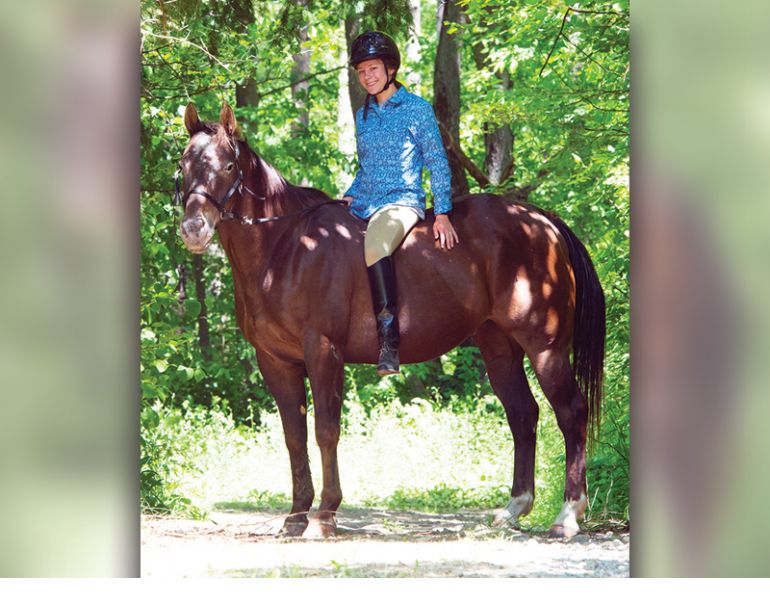
Roll a ball or massage device back and forth across the horse’s glute muscles. Photo courtesy of Jec Ballou

This exercise is more of a strength builder than a stretch. It demands the same response from the horse as when a human executes a sit-up. It is incredibly valuable for stretching the horse’s back and lumbar region as well as toning the abdominals. Do not attempt this exercise if your horse is prone to kicking.
- Stand squarely behind your horse, and make sure he knows you’re there.
- Tuck the tips of each thumb just under the dock of his tail.
- Extend your fingers straight up to form a “box” with your thumbs.
- Apply direct pressure into the horse’s buttocks muscle with the tips of your index fingers.
- If the horse does not immediately tuck or “squat” his pelvis away from that pressure, try a light tickling or scratching motion.
- Repeat three times.
Some horses are very sensitive in this area, others less so. You may need to alter your hand position to find your horse’s response.
Related: How to Use Hills for Horse Training

Standing in your front of the horse at a halt, ask him/her to step backwards with one diagonal pair of legs (i.e. left front and right hind), and then immediately ask that SAME pair of legs to step forward again. The other two legs should remain immobile. Continue this motion, rocking the horse back and forth with one diagonal pair of legs moving. Do an equal number of reps with both pairs of legs, eight reps each side. Photo: Alamy/Erickson Stock

While walking a 6- or 8-metre circle for two minutes, ask your horse to lower his/her neck nearly to the ground and bend his/her spine to match the circle arc while maintaining steady walking rhythm. Photo courtesy of Jec Ballou
Related: Heart Rate Zones for Horse Training

With your hand resting lightly on the bridge of the nose, wiggle the horse’s head slightly from side to side. Eventually, the motion should travel through the whole body. Photo: iStock/Alexander Farnsworth
Then, do a 35-minute ride that includes the following tasks in this order:
- Walk for 10 minutes on loose reins.
- The Labyrinth (Figure 6)
- The Schaukel (Figure 7)
- Clockface Poles at trot (Figure 8)
- Canter for 30 seconds
- Walk for 20 seconds
- Repeat this sequence a total of four times
- Hack around your property to round out the remaining time to reach 35 minutes.

Do this exercise for three minutes continuously; then, go immediately to perimeter of arena and trot briskly for three minutes. Repeat the sequence: Labyrinth for three minutes, brisk trotting three minutes, for a total of three times. Photo courtesy of Jec Ballou
Related: Struggling to Plan Your Horse’s Training Sessions? Here’s How to Improve

In a continuous manner, walk the horse backwards and then immediately forward the same number of steps. Take your time and work on smooth efforts here. Do eight times. Photo courtesy of Jec Ballou

Envision your 20-meter circle as a clock face and place a ground pole at 12noon, 3pm, 6pm, and 9pm.
- Now ride your horse in a lively working trot around your circle, crossing over the middle of each pole as you come to it.
- Count your strides between each pole; you should have the same stride count if you are riding correctly in rhythm.
- Be sure to keep your horse bent around your inside leg for the duration of the circle, even when crossing poles.
- Look ahead, keep a light contact with the reins, and smile.
- Do ten reps in each direction.
Building strength relies on performing — and in most cases repeating — certain exercises for a defined amount of time or number of reps followed by a recovery period. Defining these periods for each horse involves assessing their unique aptitudes, fitness levels, and exercise tolerance. The exercise durations in this article reflect Dean’s existing level of activity over the previous several weeks, his age, and his owner’s schedule, which allowed daily consistency.
Without specific guidelines, many riders misinterpret the horses’ generous spirits and do either too much or too little. In these cases, the metabolic and musculoskeletal system does not absorb gains from training. It either receives no positive gains or it ends up stressed and depleted. That said, however, conditioning plans also need to take into consideration what is realistic for horses and owners. Nothing is gained from creating elaborate plans when riders do not have the time and consistency in their weekly schedules to follow them.
Author’s note: Many of the exercises described in this article are found in my book 55 Corrective Exercises for Horses.
Related: Healing the Injured Horse with Fitness
Related: Designing an Effective Equine Fitness & Conditioning Plan
Main Photo: Alamy/Erickson Stock
Blogs & Podcasts

Advertisement

Related Articles

Advertisement

Featured Stories






Advertisement
