Discover how Ontario's Knight School teaches medieval mounted games, jousting skills, and horsemanship while making knighthood accessible to more riders.
Navigating provincial and national equestrian organizations - No single organization supports all things “horse” across Canada. Coaches, trainers, riders, drivers, owners, breeders, and the horses themselves are represented by myriad organizations.
In August 2026, four Canadian team riders and one alternate travelled to Europe to represent Working Equitation Canada at the 2026 Working Equitation (WE) World Championships in Jerez de la Frontera, Spain from September 8 to 13. It was the first time that Canadian riders had participated in the WE World Championships, which is hosted every four years by the World Association of Working Equitation (WAWE). Four of the five riders were riding leased horses.
Northern Dancer was an extraordinary horse who captured Canada’s spirit and inspired immense national pride. Northern Dancer, whose heart and spirit transcended his size, remains one of the greatest Thoroughbreds in history — a legend whose legacy continues to inspire generations.
Endurance riding places exceptional demands on horses, particularly during competitions held in hot weather over long distances. Maintaining hydration and electrolyte balance is therefore a major concern for riders and veterinarians.
While it might often be spoken about in artistic, aesthetic, or even philosophical ways, lightness — both of movement and also of communication with horses — is more than an abstract ideal. In many ways, it measures a horse’s current physiological capabilities.
One could say that to work with horses is to work under pressure: the physical pressure we employ in communicating to our horses, time pressure, and even peer pressure. A wise horseperson has a sense of timing and knows when it’s fitting to yield or resist.
There comes a time when even the horse that has carried you to countless victories begins to show signs of age. For many riders, accepting that a trusted competition partner is becoming a senior can be difficult. Yet with modern advances in veterinary medicine and improved management practices, many horses now continue to perform successfully into their late teens and even their twenties. This is particularly true in disciplines such as dressage and show jumping, where years of training and experience are essential to reaching the highest levels of competition.
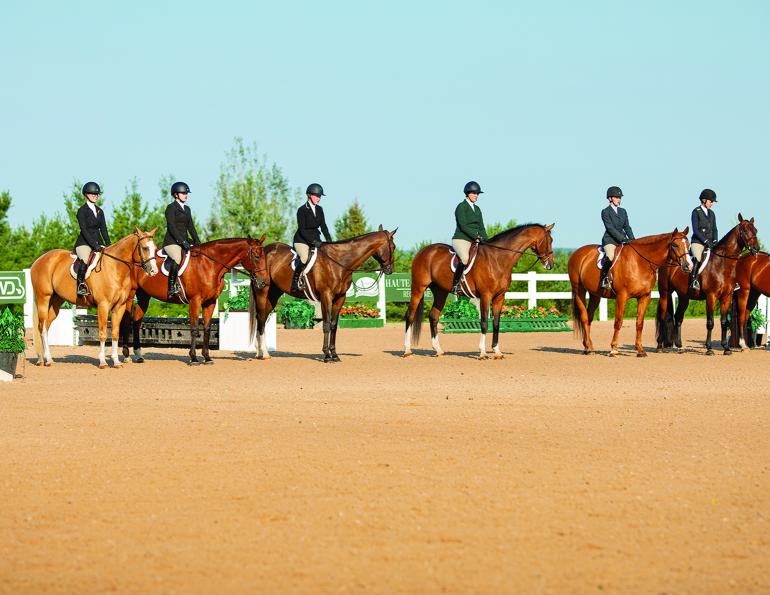
Riding the Rail - No jumps. No pylons. No letter markers. Unlike classes assessing the accuracy of patterns, the quality of movements in tests, or how the competitor meets each jump on course, flat or rail classes appraise the picture of you and your horse in profile.
A hot humid day. One rider. One horse. Both are exercising at a moderate level. Who is more likely to overheat? It might surprise you to learn that your horse gets hotter much faster than you and is more susceptible to the negative effects of heat stress. Prof. Michael Lindinger, an animal and exercise physiologist at the University of Guelph, explains: “It only takes 17 minutes of moderate intensity exercise in hot, humid weather to raise a horse’s temperature to dangerous levels. That’s three to ten times faster than in humans. Horses feel the heat much worse than we do.”