


Building the Equine Athlete With Calisthenics
Updated:
August 14, 2026By Jec A. Ballou
Calisthenics can be an important part of developing a stronger, more capable equine athlete — but what exactly does that term mean when applied to horses?
The question came up during a clinic last week while I was enthusiastically explaining how useful calisthenic exercises can be. One student stopped me to ask, What exactly did I mean by calisthenics? Chances are, she was not the only person wondering as I talked about the benefits these exercises can provide.
In general terms, the dictionary describes calisthenics as “Exercises to develop a strong, trim body.” It goes on to explain that they require little equipment or complex movement and are designed to improve strength while encouraging grace and precision.
For horses, calisthenics follow much the same principle. They are deliberate, carefully controlled movements that complement the faster and more energetic work horses routinely perform. Rather than emphasizing speed, these exercises are generally slow and precise, with particular attention paid to body alignment and the placement of each hoof.
Calisthenics are best done at the beginning of a session or during periods when a horse has become confused or stressed or fatigued, because they support the role the gymnastic muscles need to play. Without that support, the body’s larger muscles tend to create faulty circuitry, poor postural habits, and opposing muscular efforts from incorrect movement patterns. You can think of calisthenics as a compliment to your normal schooling. In fact, they allow you to go about that schooling with more efficient, successful effort.
Calisthenics exercises, examples of which follow below, are used in my programs to strengthen and release tension from areas that are neglected during even a fit horse’s everyday training. In this way, you can think of them playing a similar role to Pilates and yoga for well-conditioned human athletes. Their benefits include:
- Activation of under-utilized muscle chains;
- Stimulation of sensory nerves and improved proprioception;
- Recruitment of deep postural muscles to resolve imbalances and asymmetries;
- Increasing joint range of motion.
Because of these benefits, I generally recommend that students perform calisthenics at the start of a session prior to any deeply embedded habits from the neurosensory system firing up and carrying out their status quo. This is the best time to positively alter this system to gain the benefits listed above.
Indeed, sometimes the same exercise might serve as a schooling technique or as a calisthenics routine, and in this case the speed and intention with which the exercise is performed will differentiate its effect and outcome. Many exercises, though, stand alone in fulfilling the purpose of calisthenics as I’ve stated it above.
Some of my most frequently prescribed calisthenics include:
- Backing the horse up unmounted with perfect form for 60 strides;
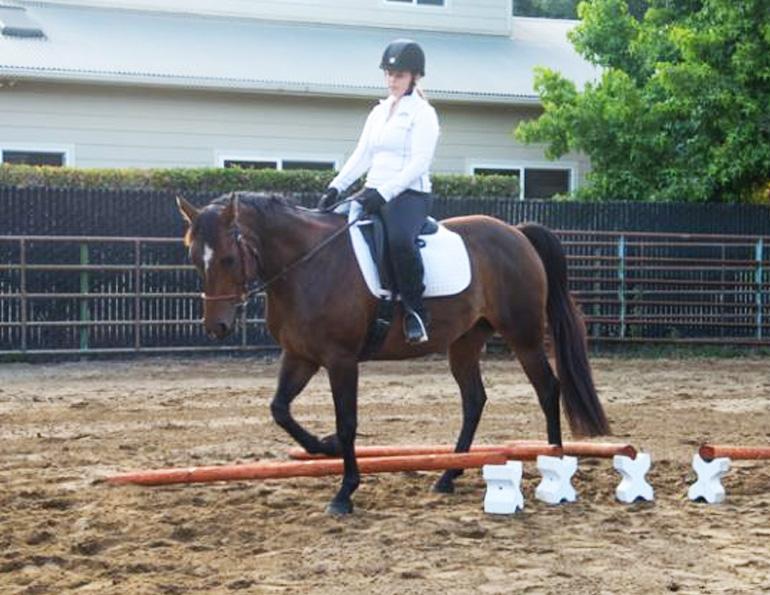
- Walking obliquely across raised ground poles;
- Riding serpentines and transitions between gaits in a long/low stretched frame;
- Walking over raised poles arranged in a tight arc, or fan shape;
- Turns on the forehand with correct inside bend, hind legs crossing, and steady rhythm.
As you read my articles, you’ll come across several other calisthenics that I encourage riders to use because they are simple and highly effective, and most likely you have come up with some of your own along the way. My goal when prescribing them is always to recruit the horse’s slow-twitch postural muscles where patterns and memories are stored. By accessing this system, we gain the ability to influence it more and more, thereby developing better equine athletes.
Related: Heart Rate Zones for Horse Training
Related: How to Use Hills for Horse Training
More from Equine Fitness & Performance with Jec A. Ballou
Main blog photo: Jec A. Ballou
Latest Blogs and Podcasts

Advertisement

Advertisement

Featured Stories





Advertisement
