


Horses with Jobs

Updated:
February 2, 2026By Li Robbins
People often say, “a horse needs a job,” as though life as an equine couldn’t be complete without trotting into the office occasionally. Historically, horses really did take on essential work, from carrying soldiers into battle to driving the gentry around town (as anyone who’s watched The Gilded Age knows.) Even in our own times, when horses are less necessary for most human activities, they’re still sometimes pressed into service. Of course, it helps if a horse is well-suited to their assigned occupation. So, before recruiting a horse for any of the following positions, consider some of the necessary qualifications.
A Patient Teacher: The School Horse
There may be no horse job more integrated into 21st century life than that of the school horse. School horses are the first equine teachers for many of us, and if you learned to ride aboard one as a child it’s likely you still remember that horse’s name. In the case of this writer, it was “Shadow,” a fuzzy black pony who possessed one of the key qualities a school horse must have, described as “the patience of a saint” by Sue Iwan, co-owner of Toronto Equestrian North, in Kingston, Ontario.

We always remember our first equine teacher, the school horse that introduced us to the joy of horses and riding. Photo: iStock/AsyaPoznick
“A good school horse is the most valuable horse a rider will ever ride,” says Iwan. “They should be versatile, a real all-rounder, have a good brain and disposition. They must be as safe as is possible, reliable, predictable, and well-trained. And they must be over five years of age.”
While it’s true that one of the chief jobs of school horses is to tote around beginners, school horses may also be required to be “scalable,” accommodating more advanced riders as well. Horses at Toronto Equestrian North, for example, sometimes take part in schooling shows, or carry their students on hacks and around small cross-country courses. That said, school horses are not usually asked to jump much more than two-foot fences for the horse’s sake.
“Riding schools appreciate the workload their school horses carry and are committed to managing that load for the sake of the horse’s health and longevity, so higher jumps are rarely an option,” notes Iwan.
While Iwan says she’s proud of their entire herd, it’s true that some horses are better suited than others to life as a school horse. She singles out a 20-year-old Quarter Horse named Coal as an example of a “quintessential” horse for the job.

Twenty-year-old Quarter Horse, Coal, has all the attributes that make him ideal for his job as a school horse. Photo: Sasha Loubert
“Coal is kind, a ‘more whoa than go’ ride, talented, safe, able to take an absolute beginner or an advanced rider,” says Iwan. “He’s a great teacher, a stickler for correctness, and an invaluable asset in teaching the art of turning and leg aids.”
Related: Horses with Jobs: Pack Horses
Delivering Joy: The Miniature Therapy Horse
When two fluffy-forelocked Miniature horses named Romeo and Ziggy first showed up at a senior’s residence in California, it wasn’t just the residents who were moved to tears, but also the Minis’ handler, who happened to be actor Daryl Hannah. She was so affected by how people responded to the little horses that she cried too, as she told NBC News.
Closer to home, Dana Johnston, based in Vankleek Hill, Ontario, is keenly aware of the impact a Miniature therapy horse can have. When she goes into nursing homes with His Nibs, her 31-inch brown-and-white pinto, “it really puts a smile on people’s faces,” she says.
“Sometimes it prompts memories, people sharing stories of their own horse pasts,” says Johnston. “As one woman told me, you have no idea how much pleasure you bring with you when you come in with that little horse.”

A Miniature therapy horse must be extremely calm and love people. Dana Johnston visits seniors with His Nibs, who is greeted with many smiles and pats, and seems to enjoy his job of delivering joy and prompting happy memories. Photos: Jane Kingsbury
Not just for pleasure, these visits have potential therapeutic results. “Engaging in Miniature horse therapy activates cognitive, social, and physical functioning,” states the American Miniature Horse Therapy Association (AMHTA), noting that visits with therapy animals can result in lower anxiety and blood pressure levels, and increased mental stimulation.
The rise in popularity of Miniature therapy horses is relatively recent, according to the AMHTA, which credits the development of social media platforms for helping therapy horse handlers to connect and share knowledge. Those connections have helped the number of Miniature horses in animal-assisted therapy to grow exponentially.
Johnston can attest to the importance of online resources, having watched many YouTube videos of therapy horses in action as well as taking an online course before she enlisted Nibs. She already had an inkling he might be suited to the role, given his love of people, an essential quality for a therapy Mini, according to the AMHTA. When Johnston began bringing Nibs home for backyard visits with local children, they clustered around him to brush and pet, and Nibs was unflappable and sweet.
As well as a gentle personality, a Miniature therapy horse must also be extremely calm when surrounded by people. Accordingly, Johnston took Nibs to outdoor markets and walked him around town (sometimes with a wheelchair) before he ever set hoof in a nursing home. Part of a Miniature therapy horse’s brief is being able to navigate safely in small indoor spaces — that and an acceptance of touch, since you can be sure that wherever a horse like His Nibs goes, people will reach out for pats.
Related: Horses with Jobs: Logging Horses
Sure-Footed Sniffers: The Search and Rescue Horse
If you’ve ever added a new supplement to your horse’s feed only to have the horse refuse even a bite, you’re well aware of horses’ keen sense of smell. Although there is limited research on the olfactory capabilities of horses, it is known that smell is a horse’s primary means of recognition. Their sensitive noses enable them to do things like gather information about individual horses; for example, it's why your horse may take such an interest in sniffing other horses’ poo.

MSAR riders Josie Rawlings (left) and Jen Ellins. Photo: Cindy Further
Humans have capitalized on horses’ superior sniffers for centuries — some accounts indicate that Indigenous Peoples used horses to scent buffalo herds. Today, mounted search and rescue (MSAR) operations put horses’ air scenting abilities to good use. One of those organizations is the not-for-profit “Ontario Mounted Special Service Unit” (OMSSU), a civilian mounted patrol that does air scent tracking to locate lost people, livestock, and products. Not all horses will be good at the job though, says Captain Jen Ellins, the OMSSU’s lead MSAR and air scent trainer.
“Some horses simply have no interest in air scenting, or they get bored too easily to go through the training,” says Ellins. “Typically, a horse that is naturally curious about its surroundings does well.”
Training is incremental, starting the horse in a small area with scent rags and rewarding the horse when the rag is touched by the horse’s nose. Over time the rags are moved farther afield, but the progress of each horse is unique, and Ellins notes there really is no “one size fits all” when it comes to training a horse to air scent. Air scenting is also only part of the job description for most MSAR horses.

MSAR Captain Jen Ellins with Ty, a horse that always does his best. “It never ceases to amaze me what a horse will go through if they trust you and you trust them.” Photo: Josie Rawlings
“MSAR horses need to be good trail horses to start with, sure-footed on different types of terrain and able to cross water and bridges,” says Ellins. “They also need to be able to split off from the herd, since although we usually stay in pairs, sometimes it’s necessary to go around a dense area of bush or a small body of water. These are some of the qualities we would look for in a good candidate.”
Given the extensive territory an MSAR horse may need to cover, it’s important that the horse has a high level of fitness and a healthy curiosity in the world at large. When an MSAR horse chooses to pay attention to something specific, the human should take note; as the saying goes: look where the horse looks.
Ellins’ own horse, Ty, has been involved in a number of searches in recent years, and she praises him for always doing his best. “It never ceases to amaze me what a horse will go through if they trust you and you trust them,” says Ellins. “He will push or pull trees out of the way and cross kilometres of underwater trail up to his belly where he’s never been before. He has no idea what the ground is like under the water; he just trusts that I do.”
Related: Bucking Horses: Unsung Athletes of the Rodeo World
Level-Headed and Confident: The Quadrille Horse
Quadrille is sometimes described as “horse ballet” since, like dancers in the corps de ballet, the horses and riders execute demanding patterns that require impeccable timing and control. As a result, when performed at a high level both ballet corps and equine quadrille showcase the beauty of synchronized bodies in motion.

The Alberta Quadrille features gorgeous Friesian horses hitched to elegant two-wheeled carriages. Photos: Mark Muilwijk
Ridden quadrille began in 17th century Europe and was performed at extravaganzas known as carrousels, which also featured mounted military competitions in between the equestrian ballet. Quadrille was used to mark significant occasions, such as weddings and coronations, and to heighten other dramatic arts; a horse ballet might follow the performance of an opera.
Today, quadrille can be both a demonstration event and a competition, famously so at the Challenge of the Americas in Wellington, Florida, where elite international riders participate in dressage quadrille as part of a breast cancer research fundraiser. The event began in 2002 and was founded by Mary Ross, who says that the Grand Prix Quadrille Team Challenge requires many months of horse and rider practice. She describes the quadrille horses as “rockstars,” noting that as well as requiring an appropriate skill level, the horses also need a particular kind of temperament.
“I believe the biggest challenge would be the horse’s ability to stay focused on the task at hand,” says Ross. “The atmosphere at the Challenge of the Americas is very electric. With all the excitement in the air it can be difficult for a horse to stay focused. A confident and secure rider-horse relationship is very important to a successful quadrille performance.”

The Grand Prix Quadrille at the Challenge of the Americas in Florida features elite dressage riders and is part of a fundraiser for breast cancer research. Photo: Susan J Stickle
The success of a dressage quadrille horse is not breed-dependent, but Ross suggests that highly sensitive and hot horses are probably not the best candidates for the role. Even calm horses may perform better in one spot in the quadrille team than another — some as lead horses, some in the middle, some bringing up the rear.
“Quadrille horses must be comfortable working in close contact with other horses and having horses coming towards them and having horses crossing closely beside them,” says Ross. “It’s also important that the horses’ scopes of movement are compatible with each other.”
There is at least one instance when a specific horse breed is required for quadrille, and that’s Friesian horse quadrille. It originated in the Netherlands and was transplanted to Alberta six years ago with the formation of the Alberta Quadrille, whose first performance was during the Friesian Horse Association of North America’s (FHANA) 35th anniversary celebrations. Modelled after De Fryske Quadrille in the Netherlands, the Alberta group drives pairs of Friesians harnessed to “sjees,” which are elegant two-wheeled carriages. While the Albertans got their start with a pattern designed in part by the Netherlands group, today their own coaches create ever more complex patterns honed through real-life practice.
Although Friesians are required for the Alberta Quadrille, Alberta Friesian Horse Association board member and Friesian horse breeder Annie Muilwijk says that, no matter the breed, there is a connection between ridden and driven quadrille. “A few members of the group had been members of ridden quadrilles and that certainly makes a difference,” says Muilwijk. “A quadrille is teamwork and paying good attention to the other drivers is a must.”

The Alberta Quadrille performing at the Ponoka Stampede. Photo: K. Shipley
Good teamwork between horses and drivers has clearly paid off for the Alberta Quadrille, which won the FHANA’s “Social Distancing Virtual Show” competition during the COVID-19 pandemic and has been in demand ever since for live performance. Whether ridden or driven, quadrille horses must be level-headed, patient, and tolerant of other horses in close proximity. However, Friesian quadrille ups the ante — to be a candidate for that job requires having the classic Friesian horse look, featuring those spectacular long manes and feathers.
Related: Jake the Logging Horse Hero
Smart and Skilled: The On-Screen Horse
It’s difficult (if not impossible) to imagine movies and television without horses. After all, an entire film genre — the Western — literally could not exist without them. Of course, there are also movies having nothing to do with cowboys that depend on the power of horses, from the many film versions of Black Beauty to the iconic movie, The Black Stallion. Or should we say stallions, plural? Although an Arabian named Cass Ole was the primary equine actor in the 1979 film, there were three look-alikes that portrayed him in scenes for which his personality was not suited. While all screen horses need to cope with the intensity of lights, camera, action, not all are appropriate for every scene or role; something Jason and Bronwyn Irwin, who’ve trained horses for television, movies, and commercials, know firsthand.

Jason and Bronwyn Irwin with Holly, Chief, and Kate — horses they have trained to perform for television, movies, and commercials. Photo: Adam Irwin
“Horses may be asked to perform high-energy scenes, and so a horse that has the ability to bring more power to the scene might be required,” says Bronwyn Irwin. “A horse that’s working directly with an actor may have a quieter personality, so they’re easier to be handled by anyone. No matter which role the horse has on a production, they must be safe and well-trained to handle the job.”

Bronwyn Irwin describes Chief as “a once-in-a-lifetime horse.” Photo: Adam Irwin
For higher energy liberty work (the Irwins’ horses specialize in liberty and tricks) the horses not only need to be patient, gentle, and safe, but their skill set also has to include things like rearing on cue or running to a mark.
“It takes a very smart and skilled horse to be able to be set loose on set surrounded by all of the personnel, equipment, and then perform a big action by taking cues from a trainer who is about 20 feet or more away,” says Irwin. “This type of performance horse has to be trustworthy and trusting of the trainer. This is really the ultimate equine performer.”

Kate rears on cue for Bronwyn Irwin. Photo: Adam Irwin
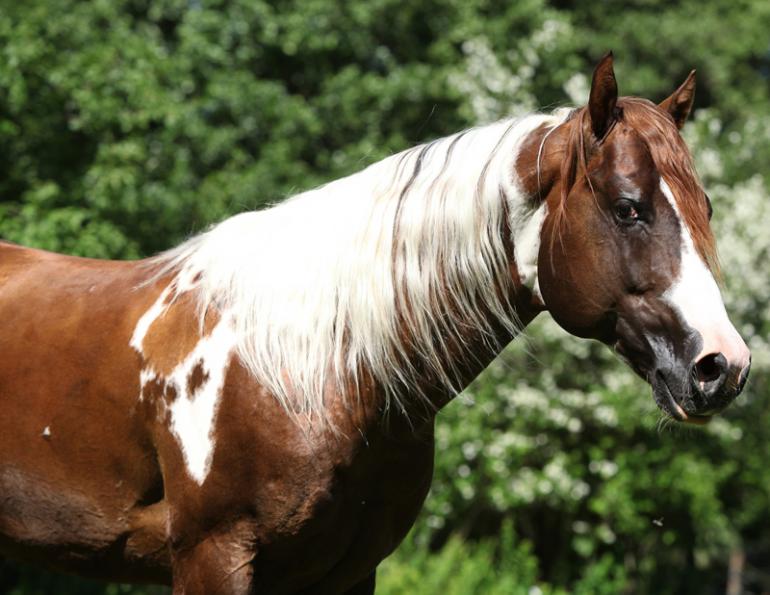
Although the Irwins are proud of the adaptability of all their horses, they single out a Paint named Chief as being extraordinary at his job. Irwin recalls a last-minute scene change in one movie shoot that required Chief to walk down a muddy hill, stop, look around, and then run from zombies who were chasing him. Chief did the scene in three takes with several camera angles — under lights in the middle of a barnyard.

The Irwins and two of their equine stars performing on Canada’s Got Talent in 2023. Photo: Canada’s Got Talent City TV
“He really didn’t put a foot wrong and wasted no time to perform his scene even with the changes,” says Irwin. “He listened to all of the cues we gave him and put a lot of effort into it. When a horse is at liberty in such a big situation it really shows how clever they are and how much trust they have in us to perform their role even when there are so many things happening around them. Chief is really a once-in-a-lifetime horse to allow us to experience such cool things.”
Related: Horses in Hollywood Movies
Related: Equine Assisted Learning: Changing Lives Through Horses
Main Photo: Alamy/Manfred Grebler
Blogs & Podcasts
Advertisement

Related Articles

Advertisement

Featured Stories





Advertisement
