Goal Setting for The Amateur Equestrian

Updated:
January 30, 2026By Abby Stilwell
Setting goals is something we are all familiar with in many facets of our lives. From the time we are kids in school, we learn about the importance of goal setting. That said, sometimes I find when I am busy managing my professional career, trying to raise two well-rounded boys, and keeping our household afloat, my equestrian goals seem to be the first to take a backseat. In fact, there’s almost a certain element of guilt associated not only with prioritizing those goals above other things in life but even taking the time to effectively set and monitor those goals, period. My husband is the first to call my riding an “expensive hobby” and although it irritates me when he refers to it as such, in truth he’s not entirely wrong. Even though it is something I am passionate about and something that fills my heart, it doesn’t put food on the table or pay the mortgage — truth be told, it makes those things harder.
Because most of us are amateur riders with limited time and money, my recent revelation is that our circumstances make it even more critically important for us to be setting, and strategically working toward, our goals. I recently shifted my mindset from thinking that spending time formally setting, measuring, reflecting, and working toward these goals was wasting time when I could be riding, to seeing it as me being more efficient with the precious time I have to ride and immersed in my equestrian passion. This led me to start looking into the most effective way to set and monitor short- and long-term goals in a manageable and meaningful way, focusing on time being our most precious commodity.
As I looked into various principles of effective goal setting, a few key things stood out:
1. Write it down.
- Map out your goal clearly with short-term checkpoints. Change happens as a result of small, incremental steps.
- Include emotions as part of the goal-setting process. How will it feel to achieve this goal?
- Create a visual representation of your goal and place it in a highly visible location.
2. Make it measurable.
- An unmeasurable goal is worthless, since you’ll never know when you have arrived at the finish line.
- Track your progress along the way. Find a way to keep records of what you’re working on so that you have tangible evidence.
3. Schedule time to review your progress and reflect on what’s working and what’s not.
- Literally add this to your calendar and take 15-20 minutes to review what is working and what isn’t. Most research suggests monthly or quarterly as the best timeframe for this.
- Make adjustments to your plan where necessary. Like a camera capturing a moving target, you need to keep refocusing.
Involve others (your coach, a fellow equestrian, your spouse).
- Many people fear sharing their goals in case they don’t achieve them but sharing them will keep you accountable.
- Seek guidance from professionals by asking specific questions or researching specific skills. There is a wealth of knowledge available at our fingertips (listen to podcasts, watch professionals, read and research specific things you’re wanting to improve).
Maintain a positive, growth mindset.
- Take time to celebrate growth on a regular basis.
- Even if you’re not where you were hoping to be at a certain time, don’t focus on what you can’t yet do, make sure you’re focusing on things that are positive. Maintaining a growth mindset is significantly more powerful and likely to result in improvement.

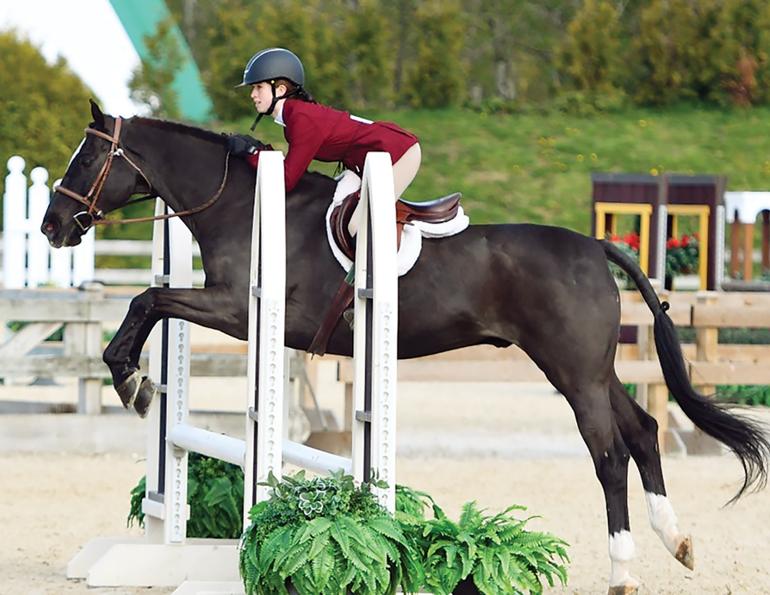
Competing in the 3' Hunter classes last summer with my horse, Open Sail RSH.
For the past three years, my goal has been to compete in the 1.0m jumper classes. I haven’t formalized this goal, just told some friends that this is my goal and thought about it myself. Well, needless to say, I have yet to ride in a 1.0m jumper class at a show. Therein lies my motivation for writing this article.
How do I actually — FINALLY — achieve my goal?
What do I need to do differently?
Clearly what I have been doing isn’t working. I spend lots of time riding and researching ways to improve, but I think my biggest mistake has been not writing my goal down and/or mapping it out. I haven’t been intentional. Which is ironic, since as a teacher and principal, I spend a big part of my day focusing on taking curricular outcomes and mapping them out into meaningful lessons that result in learning and improvement. We talk about assessment measures and accurately reporting progress, and yet, in my equestrian life, I am not doing this at all.
So, as we welcome 2026 — The Year of The Horse — I am looking forward to taking a different approach to my goals as an equestrian. I am going to be more intentional with the precious time I have to ride, and that starts with goal setting.
There are many templates and journals available online for free or to purchase. If you’re not up to creating your own template from scratch, it’s worth doing a search and finding what works best for you.
More from North Country Equestrian with Abby Stilwell
Photos are courtesy of Abby Stilwell.
Main Photo: Smiling on the way out of the ring, even though we had the final fence down, because the rest of the course was amazing and my horse felt great.
Latest Blogs and Podcasts


Advertisement

Advertisement

Featured Stories







Advertisement