


How Horses’ Brains Work

Updated:
July 11, 2025And Why It Matters To Riders
By Li Robbins
Humans have been known to have a superiority complex: a belief that we deserve dominion over the fish in the sea, the birds in the sky and, well, everything everywhere. Given our capacity for rational thought, not to mention our linguistic and creative abilities, we tend to see ourselves as the big cheese in the universe.
Non-human animals, on the other hand, have historically been viewed as lesser. A bird may sing, or a horse may whinny, but such things have often been dismissed as merely instinctual. So, back in the 1970s, when noted scientist Donald Griffin suggested animals could both think and reason, (acknowledging the ways in which they do so might be vastly different from ours), he opened the door to scientific inquiry into animal minds.
Related: Horse Safety and Trust: Rethinking How We Train
Intentionally or not, he also opened the door to an important question: are human smarts always the best kind? After all, anyone working with horses knows that horse smarts can help you out, whether it’s the horse who reminds you to put her fly mask on, or the horse who refuses to enter a forest where a bear is lurking.
In 2024, a horse-brain related study made mainstream news (a rare thing indeed), with headlines stating, “Horses Are Smarter Than Previously Thought.” The study, published in the journal Applied Animal Behaviour Science, was based on an experiment demonstrating that horses are more cognitively advanced than previously believed. Whether or not that conclusion is correct remains to be seen, but certainly the way in which the study was reported indicates just how excited we get at any hint that horses are smart like us.
Perhaps part of that excitement is because these days domesticated animals are less likely to be viewed as pets and more as family members, and when we feel close to a member of another species, we feel literally akin. Still, when it comes to horses, Janet L. Jones, author of Horse Brain Human Brain, The Neuroscience of Horsemanship, suggests that riders might be better off focusing on our differences instead.

Horse Brain Human Brain, by Janet Jones
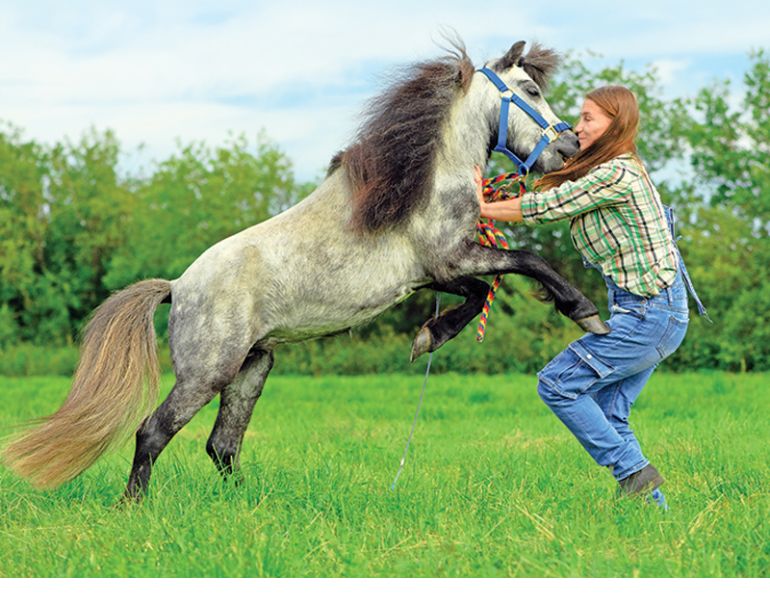
“Emphasizing similarities between horses and humans encourages us to imagine that horses have human attributes,” says Jones. “Like the ability to reason, judge, assess risk, understand consequences and so on. When the horse makes a mistake, too many people are quick to blame, assuming that [it was] on purpose, with intent to harm us somehow. And that can cause punishment, or worse, to rain down on an innocent animal who was just being a horse.”
Gaining an understanding of how horses view their world can have numerous benefits, including the potential to improve safety in the saddle. As Jones points out, riding is a high-risk activity in which the sport’s “equipment” is a living and breathing creature “governed by a skittish prey brain.” As well, understanding the differences between human and horse perception and cognition inevitably matters when it comes to performance.
Related: Karen Rohlf’s Dressage Naturally
“For example, if your horse can’t even see an approaching jump very well, she can’t possibly do her best in clearing it with good form,” says Jones. “[Or] if you train strictly by applying pressure and releasing it, you’re limiting your horse’s ability to learn in all the other ways that do not demand pressure and are therefore more effective. And so on for attention, memory, coordination, emotion, communication, and all forms of sensory detection.”
Horses experience much of life through their senses, notably the famous five: sight, smell, touch, taste, and hearing. While understanding how each equine sense works can be valuable (e.g., knowing that a horse’s whiskers may help detect a bit coming his way should make you think twice about shaving them off), arguably the sense that creates the most obvious human-horse misunderstandings is vision — and we’re not just talking about the famous blind spot behind the tail.
Related: Horses Are Smarter Than Previously Thought
Horses have eyes that are eight times bigger than those of humans, so you might assume they’d be able to make out a great deal of detail — but if you did, you’d be wrong. The jump in front of you that’s crystal clear: not to a horse. The innocent puddle of pee at the other end of the arena: scary stuff since a horse can’t see much below eye level and nothing below her nose (at least not without a major head shift). Take the transition from light to dark; horses’ eyes adjust to changes in lighting much slower than ours, creating problems when going from a bright, sunny day into a dimly lit arena.
Then there’s the obvious. Our eyes are in front of our heads; horses’ eyes are on the sides. Their panoramic range of view means that ill-defined objects may loiter mysteriously to one side or the other, or — even worse! — approach from behind as if to give chase. Spooks become more comprehensible (and your strategies to deal with them may improve) once you’ve viewed the world through a horse’s eyes. That’s something you can experience, virtually at least, via the 2024 documentary, Horses & The Science of Harmony, available on YouTube.
Related: Why Won't My Horse Load into a Trailer?
The documentary provides detailed analysis of the differences between horse and human vision. In fact, the analysis is based on Jones’ Horse Brain, Human Brain. Her work also underlies the film’s stunning digital illustration demonstrating true cross-species communication — the science behind why, when riding, you may feel as though the horse is reading your mind. Achieving this sense of attunement requires a rider to have fine-tuned body awareness (i.e., proprioception), the horse ditto, creating a cross-species neural communication loop, one where horse and human activate each other’s neurons in their brains. If that wasn’t remarkable enough, viewed in light of the vastly differing natures of humans (predators) and horses (prey), this meeting of minds — or at least brains — is nothing short of extraordinary.
Naturally, anyone who’s experienced that magic with a horse will crave it again and again. A rider seeking to create the best circumstances to achieve that sense of harmony on a consistent basis would do well, says Jones, to focus on “less rather than more,” by taking into consideration horses’ “exquisite sense for touch.”
She says, “Instead of working to become stronger, heavier, more assertive with a horse, do the opposite. Teach your muscles and nerves to supply and control very light gentle touches. If your horse doesn’t pay attention to them, that’s because she’s had a lifetime of overriding and needs to be retrained for subtlety.”
Related: What Your Horse Experiences Inside a Trailer
Another recommendation is to pay more attention to a horse’s feedback, modifying your responses rather than constantly sending the horse new messages.
“Shut up for a while, consider carefully what the horse is conveying to you, and try different techniques of meeting his needs,” says Jones. “We think too much about horses meeting our needs and not enough about how we can meet theirs.”
Equine brain science is complex stuff, and a relatively new field given that the first precise magnetic resonance imaging of a horse’s brain was only published in 2019. For riders just beginning to take an interest in how their horses’ brains work, start by acknowledging that we do not experience the world in the same way a horse does.
“A horse’s brain is designed for vigilance, ours for concentration,” says Jones. “She communicates with her body, conversing with us all the time. Most of us barely notice her body language, ignoring almost every message she conveys. Her memory is fantastic while ours is riddled with overconfidence and engineered forgetfulness. Tasks that we have to strategize or reason out, she can remember. And so on.”
Related: Navigating the Gate with Your Horse
No doubt future research will uncover much more about equine brains, but any rider can use today’s knowledge to try and avoid common mistakes, such as asking for too much too quickly. Horses learn one task at a time, and a green horse in particular needs everything explained, from how to step over a pole in the arena to being shown that a hose is not a strange and dangerous snake.
Positive reinforcement can also play a significant role, but it doesn’t necessarily have to be food-based, as those with horses who love scratches (to name just one example) well know. If you are using edible rewards, Jones recommends saving them for special performance and giving them at “the perfect moment to achieve neurochemical action in the horse’s brain.” The reward must follow the noteworthy behaviour within a couple of seconds for it to be reinforced in the brain.
The moral of the story: As riders it’s our job to be a horse’s teacher. Or, as Jones puts it, “It’s our responsibility to understand how difficult it is for a prey animal to live in a human world, then to try to make their job easier.”
Related: A Study on Blindfolding in Horse Handling
Related: Horses that Refuse Due to Confusion
Main photo: Dreamstime/Callipso88
Blogs & Podcasts

Advertisement

Related Articles


Advertisement

Featured Stories


Advertisement
